- IThe Foyer
- IIWork in Progress
- IIIThe Series
- IVThe Artist
- VPrint Shop
- VIYour Collection
- VIIStudio Journal
- VIIICorrespondence
Christopher Watson · Fifty Paintings
The Golden Age
A monument in oil to the era before the automobile claimed the road
| 1 | Luna | Oil on canvas · January 2026 |
| 2 | The Crescent Moon | Oil on canvas · January 2026 |
| 3 | Girl on a Bridge - Day | Oil on canvas · February 2026 |
| 4 | Girl on a bridge - Night | Oil on canvas · February 2026 |
| 5 | Tour de France - 1927 | Oil on canvas · February 2026 |
| 6 | The Three Sisters | Oil on canvas · March 2026 |
| 7 | Stone Fountain | Oil on Canvas · April 2026 |
| 8 | The Telescope | Oil on Canvas · April 2026 |
| 9 | Couch Theory | Oil on Canvas · May 2026 |
| 10 | 1903 Tour de France | Oil on Canvas · May 2026 |
| 11 | Pure Joy | Oil on Canvas · June 2026 |
| 12 | Alpine Ascent | Oil on Canvas · June 2026 |
| 13 | Hotel de Ville | Oil on Canvas · July 2026 |
1880–1935
Between 1880 and 1935, the most important shift in personal freedom in modern history took place, and it was never properly painted.
Before the bicycle, mobility was narrow and defined by means. You either walked, relied on a horse in some form, or depended on the railway if it happened to connect where you were to where you needed to go. Railways linked cities, not daily life. Horses required money to own or hire. For everyone else, the world was small, and life unfolded within walking distance.
The modern world had already arrived: industrial cities, paved roads, a working middle class with leisure time and some small disposable income. The automobile had yet to claim it. For roughly fifty years, the bicycle became the fastest, most personal, and most democratic machine in existence. It expanded the physical boundaries of a human life for millions of people at once.
A working man in Lyon or Brussels or Milan could own one. A woman could ride one unaccompanied, and no one could reasonably stop her. A boy from a village with no railway could ride to the next town, and the town after that, and suddenly the radius of a life that had measured fifteen kilometers for a thousand years stretched to something approaching infinity.
“I think [the bicycle] has done more to emancipate women than any one thing in the world… It gives women a feeling of freedom and self-reliance… the picture of free, untrammeled womanhood.”
Susan B. Anthony, 1896
This window closed. The automobile arrived for the masses in the 1920s and the roads cyclists had built their culture on belonged to something else within a decade. The golden age ended without ceremony. It ended with traffic.
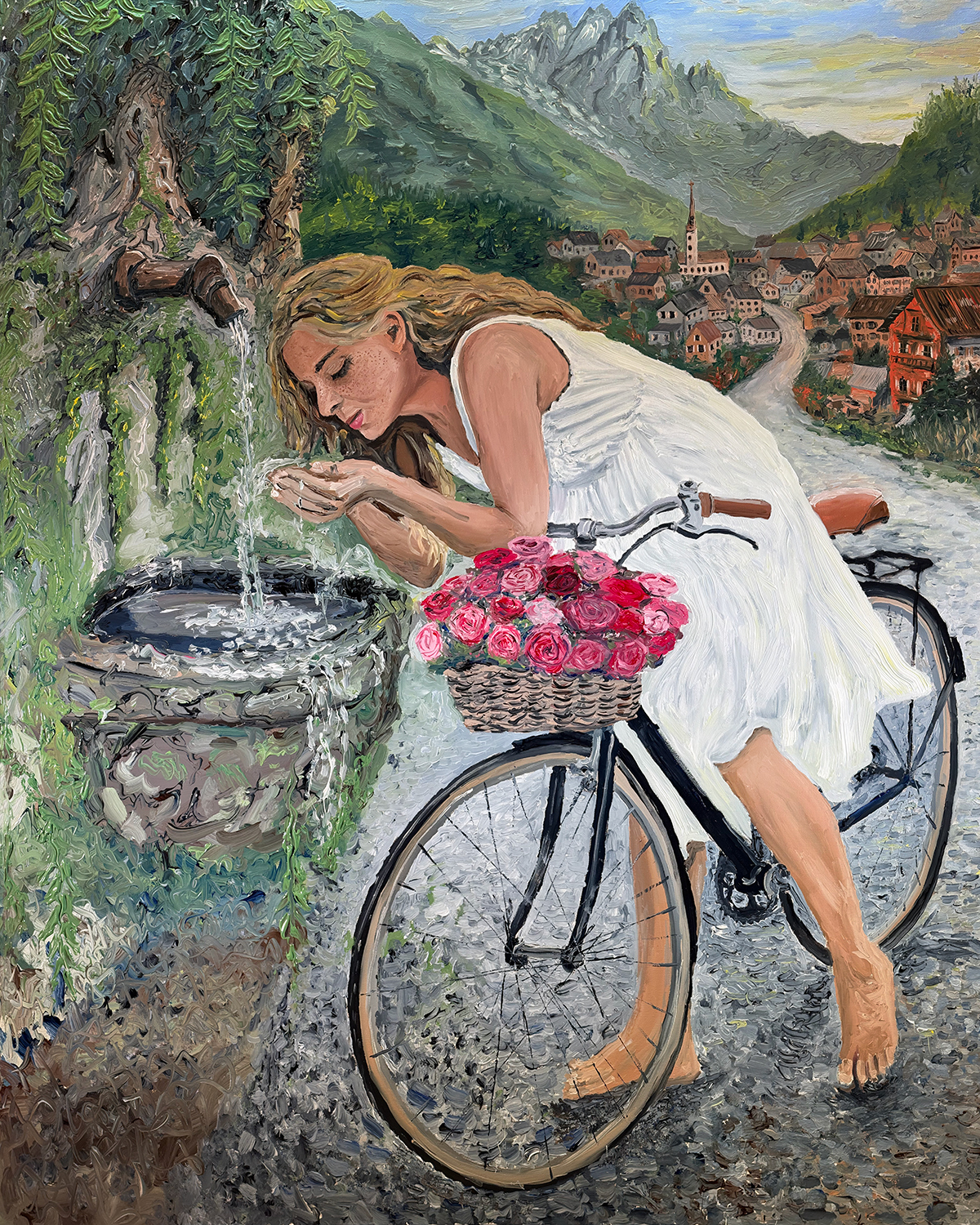
The bicycle they rode
We have romanticized almost every machine of the twentieth century except this one. The locomotive has its Turner. The automobile has its Route 66. The airplane has its Lindbergh. But the bicycle, the machine whose riders demanded better roads and then watched cars claim them, that gave a generation its first taste of personal speed, has no monument.
The bicycle of the golden age was a serious object. Steel tubing, leather saddles, woolen jerseys, tires sewn shut by hand. A typical machine weighed thirty pounds or more, built for durability rather than speed, with thick tubing, upright geometry, and the kind of mass that reminds you it exists on every climb. It asked something of you every time you got on it. To ride from Paris to Bordeaux in a single long summer day was considered an athletic feat worthy of front-page coverage. And people did it. Riders who were also their own mechanics, who stopped at farmhouse kitchens for wine and bread, who navigated mountain passes that had no names on any map by the angle of the morning light.
There is an honesty to that machine and to the people who rode it that is worth preserving. Worth painting, specifically.
The commercial response to the bicycle was immediate and global. Within two decades of its mass production, hundreds of shops had opened across Europe and America. Dozens of manufacturers competed on price, frame geometry, tire specification, design. The bicycle was among the first consumer goods aimed squarely at ordinary working people, and it sold at a scale that rewrote the economics of urban mobility.
The poster artists arrived with it. Newspapers hired illustrators. Manufacturers commissioned full-color lithographs. The cities filled with cycling imagery: sprinting riders, open roads, women traveling unaccompanied, mountain silhouettes against evening light. The artists who made these images brought real skill to the work. You can see it in what survives: the care in the draftsmanship, the thought given to composition, the quality of light they managed to render in four-color print.
You can also see what happened to most of it. The brand name placed large over the horizon. The shop address printed across the middle distance the artist had spent time on. The logo in the corner that tells you who paid for this, and makes clear who the image actually belonged to. These pictures were made as commerce, and commerce collected what it had bought. The original intention, the image as an image, survives in the margins where the text did reach.
These paintings have no logo to place over them.
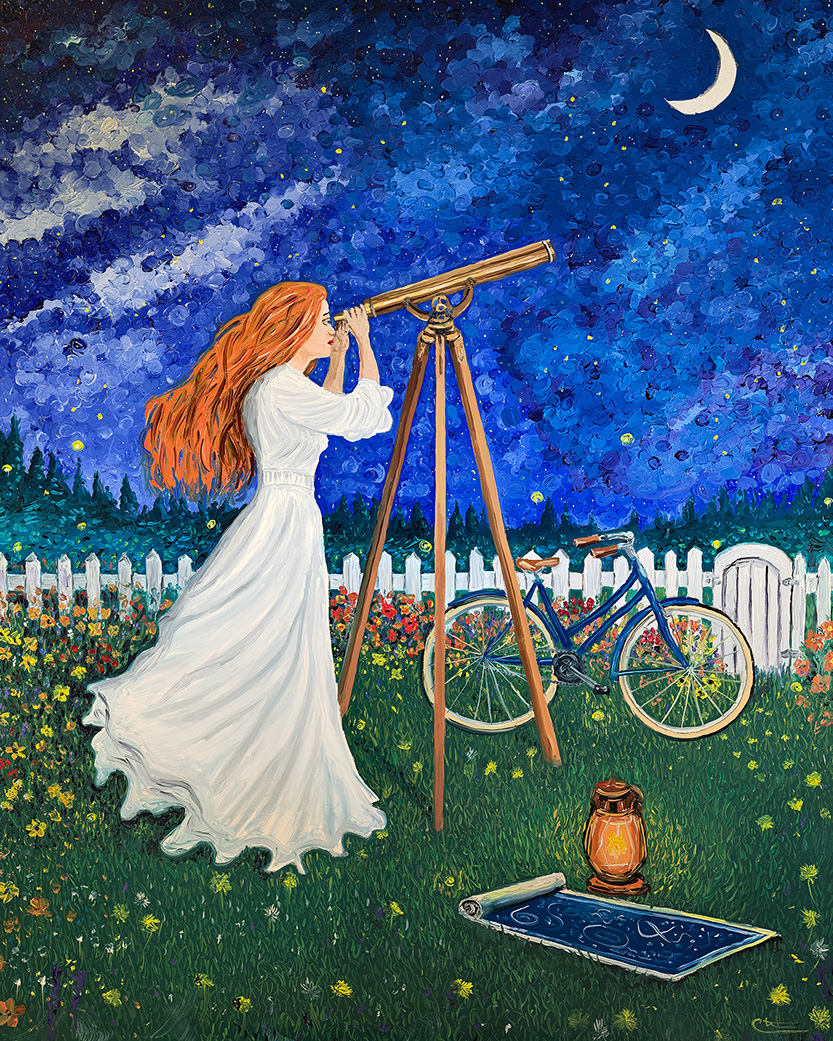
Before the cameras arrived
The grand tours we know today (Tour de France, Giro d’Italia, Vuelta a España) were born in this era, and they looked nothing like what they are now. The first Tour de France, in 1903, was something closer to a mounted expedition than a modern sporting event. Riders started at midnight. Spectators lined the road with lanterns. The road surfaces were unpredictable and the distances were full overnight stages across entire regions rather than competitive segments.
There were no team vehicles following the peloton. No radio support. If you punctured in a mountain pass, you repaired it yourself, or you abandoned the stage. Riders carried their spare tires in a coil over one shoulder, their food in musette bags, and they carried cigarettes, because in 1927 no one had yet connected them to anything other than calm nerves and a steady heart rate at altitude.
The photographs from these races show something that no longer exists: the sport before it became a product.
Their faces show something closer to complete absorption than the controlled exertion of modern televised sport: a man doing the hardest thing he has ever done, never for a broadcast contract, but because the road is long and the mountains are real and there is a specific joy in having legs that still work at the end of a day like that.
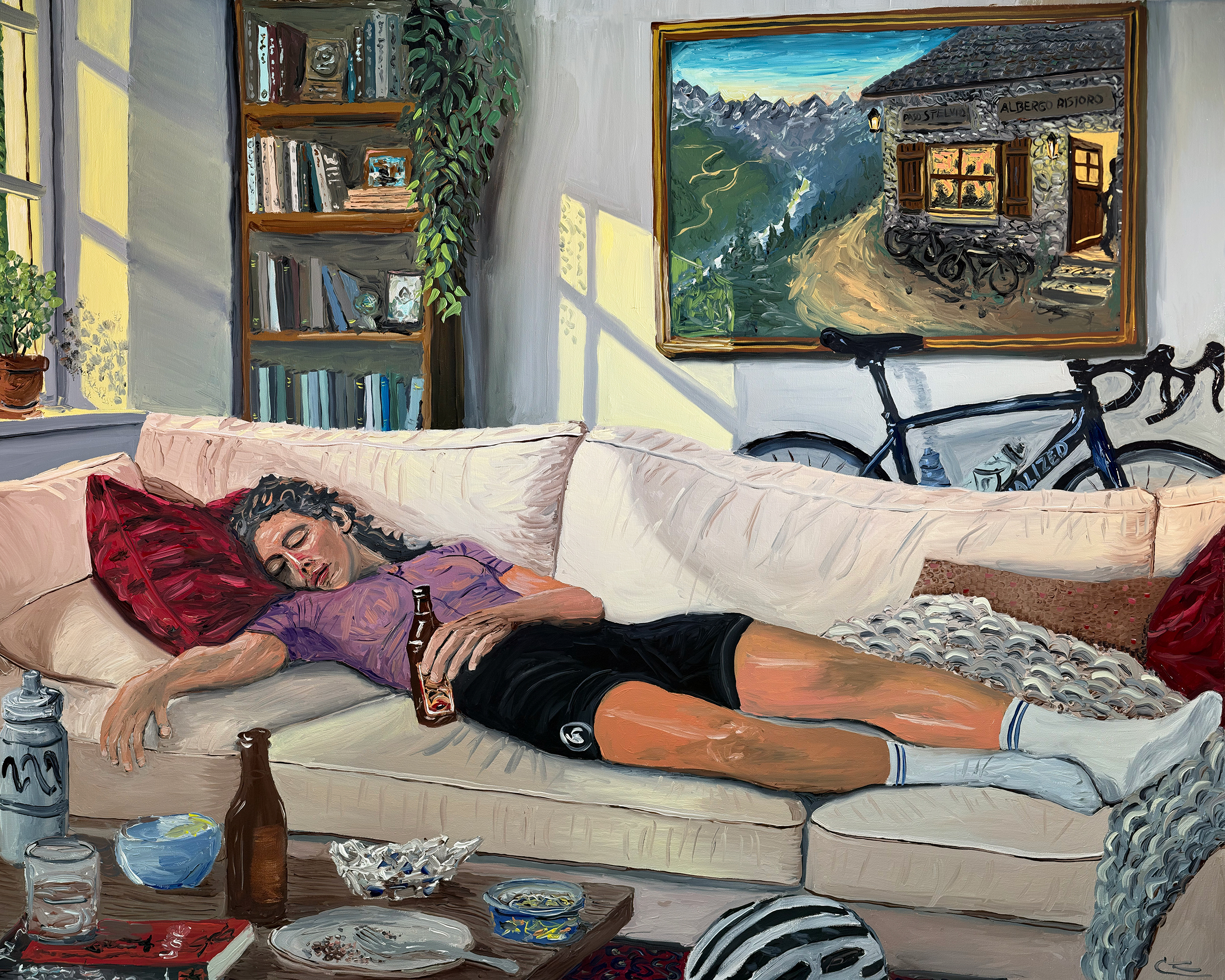
Wool, steel, and the quality of light
There is a particular palette to this era that exists nowhere else in the history of sport. Wool jerseys in the colors of early trade sponsors: aperitif brands, bicycle manufacturers, regional newspapers. Cobblestone roads that turn violet in the rain. Mountain landscapes still undeveloped, where the only mark of human presence is the white limestone dust of a road and a single figure moving through it.
The light in northern France in July. The olive-gray of an Alpine pass in October. A velodrome at dusk, its wooden track worn pale where ten thousand wheels have polished it over twenty years. These are the essential materials. They are the specific visual register of a specific human moment, and they are exactly what large-scale oil painting was made to hold.
Paint reaches where the photography of this era never could. It can hold the quality of light on a cold start in the dark, the texture of a chamois jersey at close range, the way a rider’s silhouette changes against a sky when he is completely spent and riding on will alone. These paintings try to answer one question: what did it actually look like to be there?
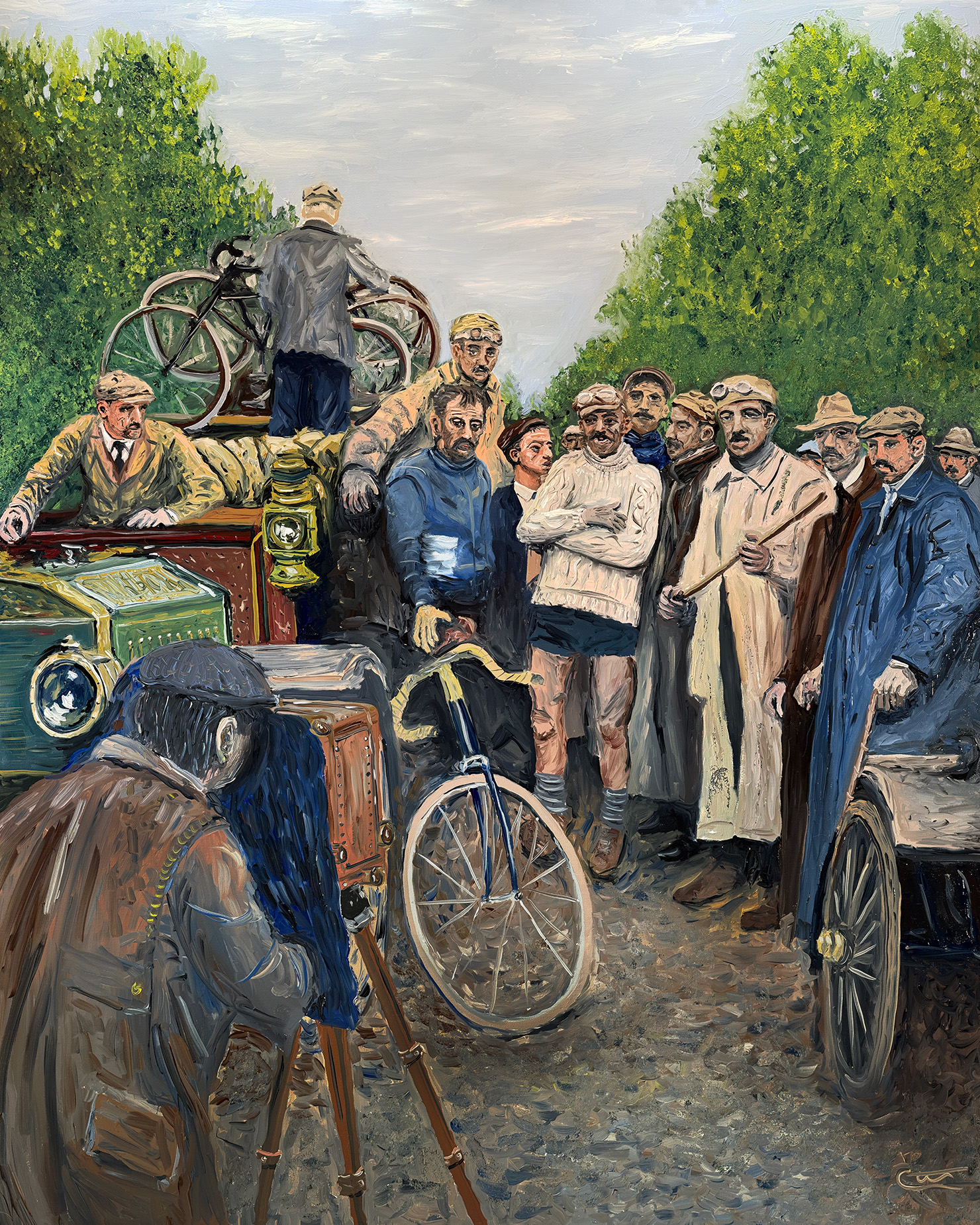
Fifty paintings.
One argument.
This is a series of fifty paintings. All large scale. All oil on canvas. All drawn from the period between roughly 1880 and 1935, the golden age.
No survey of cycling history, and no celebration of winners. A monument to a specific window of time: the years when the machine that would shape the modern world was still young, still human-scaled, still equal. Before corporate sponsorship. Before aerodynamics. Before the sport became a broadcast product and its riders became brands. When the race was simply the road, the rider, and whatever the weather decided to do that day.
The argument the series makes is simple: this era deserves the same cultural weight we give to other romantic periods of human history. The samurai. The American West. The Age of Sail. Each of these has been memorialized in paint, at epic scale, because paint at scale is the form that says this mattered, this was real, pay attention.
The golden age of cycling had its own heroism, its own specific beauty, its own cast of ordinary people doing extraordinary things. These fifty paintings are its monument.
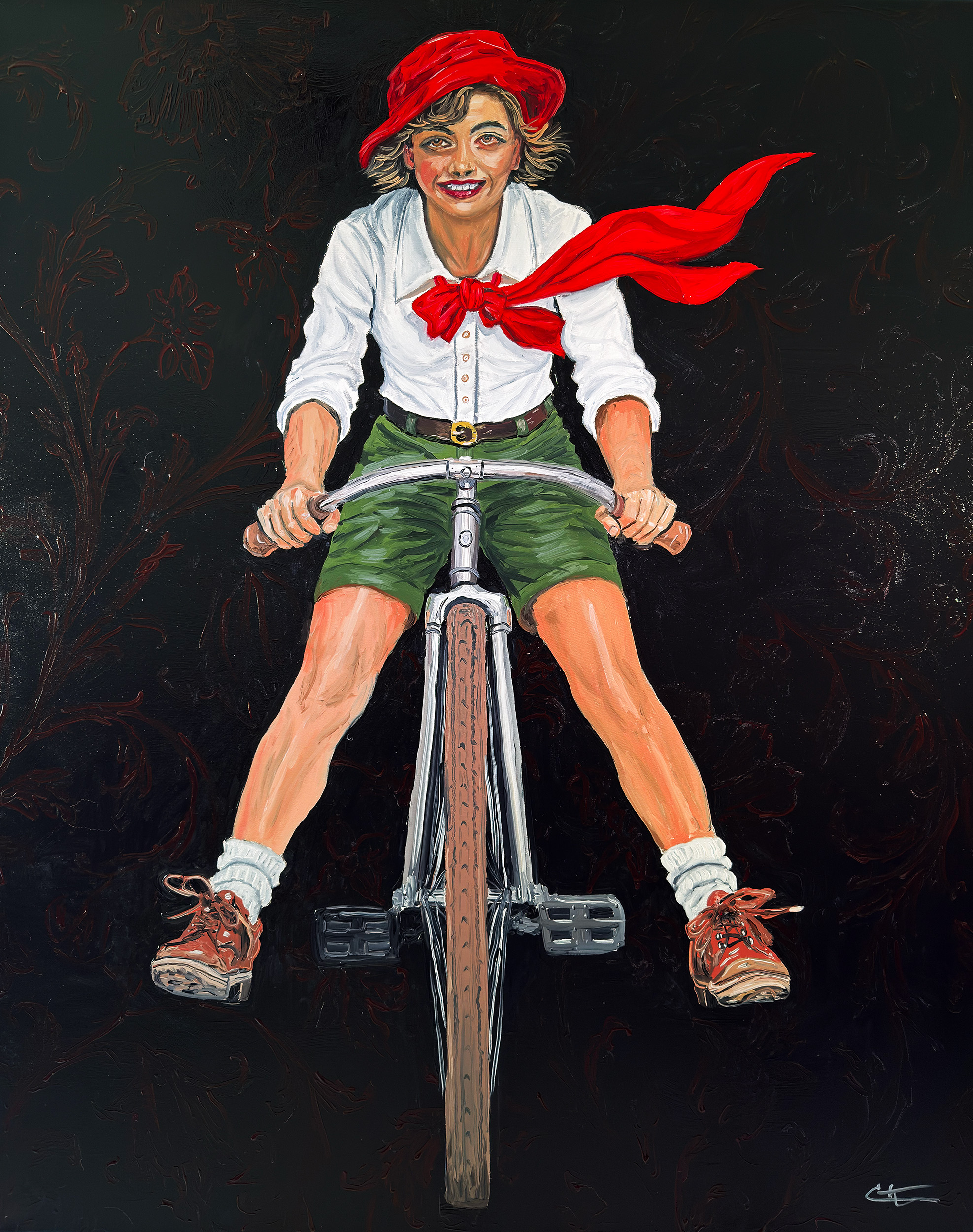
Works in the Series
13 of 50 paintings published
| 1 | Luna | Oil on canvas · January 2026 |
| 2 | The Crescent Moon | Oil on canvas · January 2026 |
| 3 | Girl on a Bridge - Day | Oil on canvas · February 2026 |
| 4 | Girl on a bridge - Night | Oil on canvas · February 2026 |
| 5 | Tour de France - 1927 | Oil on canvas · February 2026 |
| 6 | The Three Sisters | Oil on canvas · March 2026 |
| 7 | Stone Fountain | Oil on Canvas · April 2026 |
| 8 | The Telescope | Oil on Canvas · April 2026 |
| 9 | Couch Theory | Oil on Canvas · May 2026 |
| 10 | 1903 Tour de France | Oil on Canvas · May 2026 |
| 11 | Pure Joy | Oil on Canvas · June 2026 |
| 12 | Alpine Ascent | Oil on Canvas · June 2026 |
| 13 | Hotel de Ville | Oil on Canvas · July 2026 |
The paintings are in the gallery. Walk through what exists of the series so far.
Enter the Gallery