The Sixth Stage - Nantes to Paris
The riders departed Nantes in darkness. The final stage covered 471 kilometres - 292 miles - an almost unimaginable overnight effort that delivered them into Paris the following afternoon. Maurice Garin claimed the stage victory after spending 18 hours and 9 minutes in the saddle for that final leg alone.
Much of the race unfolded under minimal lighting on roads made up of dirt, crushed stone, loose gravel, wagon ruts, and mud. No protected convoy. No support vehicles shadowing each rider through the night. Just men on bicycles moving through the French countryside in the dark, navigating by whatever light was available, carrying everything they needed on their bodies.
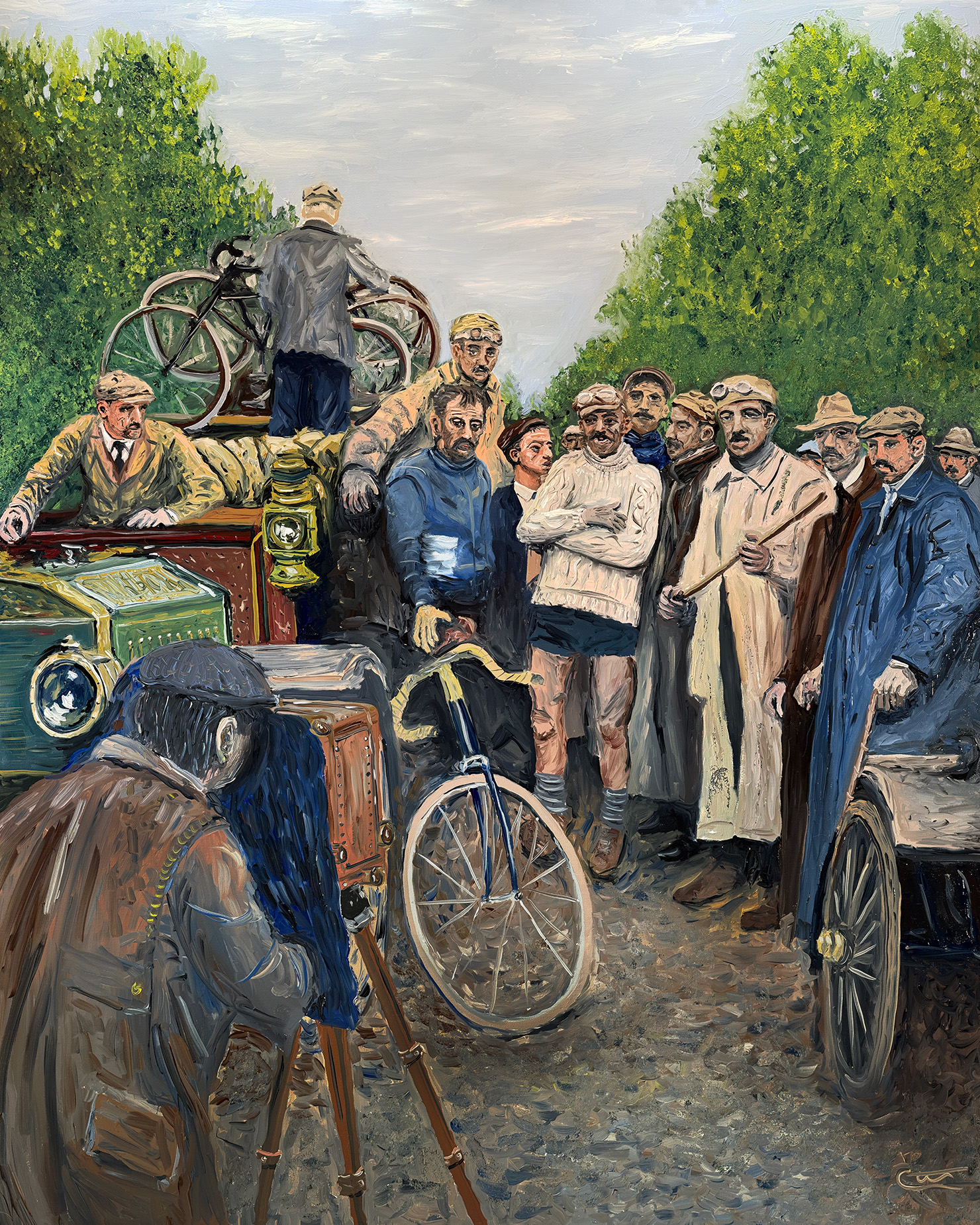
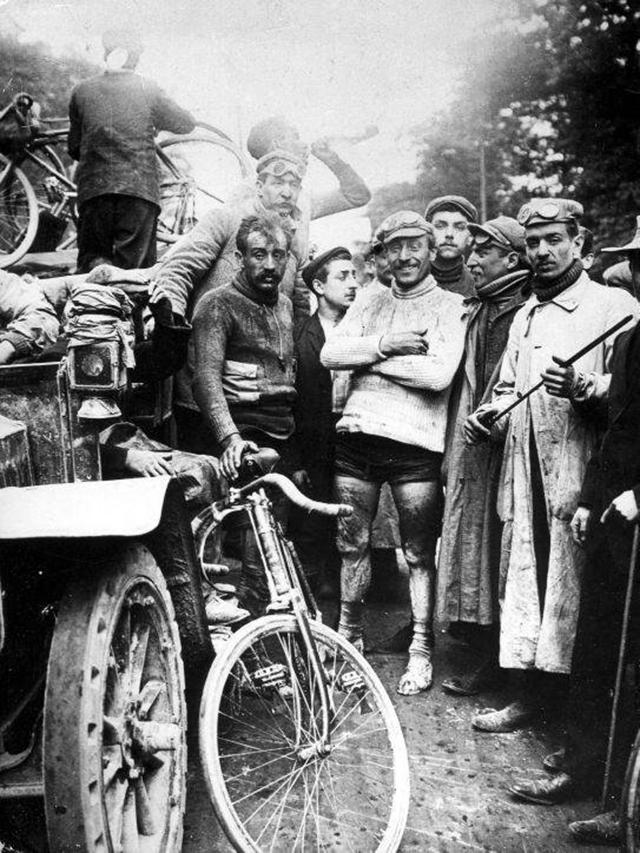
The official stage conclusion was at Ville-d’Avray, just outside Paris. From there the exhausted riders were escorted into the Parc des Princes velodrome, where they completed ceremonial laps before an estimated crowd of 20,000 spectators. The photograph that became the reference for this painting was taken somewhere in that final sequence - at the point of arrival, before the ceremony, when the racing had ended and the riders had not yet decided what face to put on for the crowd.
That is the moment I was most interested in painting.
The Two Men in the Frame
The two featured riders in the painting are Léon Georget on the left and Maurice Garin on the right. Everyone else visible in the frame - and the photograph is dense with figures - were drivers, race organisers, journalists, mechanics, or support personnel connected to the Tour.
Maurice Garin - Stage Winner & Overall Champion
Born in the Aosta Valley of northern Italy in 1871, Garin came to France as a child and worked as a chimney sweep before the bicycle changed the direction of his life. He was known as Le petit ramoneur - the little chimney sweep. He won the first Tour de France in a total time of 94 hours and 33 minutes. He was 32 years old. He would live to 85, long enough to see the race he won become the most celebrated annual sporting event on earth.
Léon Georget - Stage Finisher
Georget was a professional cyclist who would go on to compete in multiple Tours de France in the years that followed, becoming one of the more recognisable figures of early French professional cycling. In 1903 he was still establishing himself. His presence in this photograph places him at the conclusion of the inaugural race, part of the small and exhausted group who crossed into Paris that July afternoon.
The Drama Beneath the Surface
What makes this particular photograph so compelling to me is that beneath the exhaustion and the crowd and the apparent celebration, there was already significant tension brewing - tension that foreshadowed the chaos soon to consume professional cycling itself.
By the beginning of Stage 6, Maurice Garin had effectively secured overall victory in the Tour. But he still desperately wanted to win the final ride into Paris and cement himself as the unquestioned hero of the inaugural race. Most riders appeared willing to concede the stage to the overall leader. Fernand Augereau was not. He wanted the victory for himself.
Historical accounts suggest the situation escalated badly near the finish. Lucien Pothier was accused of interfering with Augereau during the sprint, while Garin himself was later accused of damaging Augereau’s bicycle following a crash. Despite the incident, Augereau reportedly continued toward Paris on a replacement machine, earning admiration from the crowds even as Garin officially claimed both the stage victory and the first Tour de France overall.
Fernand Augereau - 3rd Place Overall
A Parisian who represented the urban working-class character of early French cycling, Augereau finished third overall and completed all six stages. His refusal to concede the final stage to Garin - and the bitter incident that followed near the finish - was an early glimpse of the raw, unregulated nature of professional competition in 1903. The sport barely had rules yet. What happened on Stage 6 existed in the space between racing and something else entirely.
Lucien Pothier - 2nd Place Overall
Pothier was a road mender from Normandy - a man who built the very surfaces he would later race across. He finished more than two hours behind Garin, which in the context of a 94-hour race describes the difficulty of the course more than any gap between the men themselves. He was 20 years old. His role in the Stage 6 controversy remained contested in the historical record.
Looking back at those final kilometres, the entire scene reads like an early glimpse into something that had not yet found its shape. Alliances, intimidation, sabotage, exhaustion, survival, and ambition all compressed together across nearly 300 miles of overnight racing on primitive roads. There was no mythology yet to hold it together. No sacred tradition to appeal to. No yellow jersey, no established rules of conduct between competitors. Just men making decisions in real time in the dark.
The Following Year
Just one year later, the 1904 Tour de France would erupt into full scandal. Cheating, violence, illegal pacing, crowd interference, and mass disqualifications were severe enough that the entire race nearly collapsed before it had truly begun. Maurice Garin, who had stood in that photograph as the first champion of the first Tour, was disqualified from the 1904 results entirely following an investigation into systematic rule violations.
In retrospect, the tension visible in the photograph - the exhaustion, the dispute, the quietly satisfied victor and the rider who felt wronged - was not an aberration. It was a preview. The Tour de France was an experimental idea created to sell newspapers. They were inventing the rules in real time while riding through darkness on dirt roads across France, and some of them were already testing the boundaries of rules that had not been written yet.
The fact that the race survived, evolved, and became what it is 123 years later is not inevitable. It is the result of the sport choosing, repeatedly and over decades, to become something worth preserving. The men in this photograph were part of that choice before they understood what they were choosing.
On Painting People Who Are Gone
Every person in this photograph is gone. Most have been gone for a lifetime.
There is a particular quality to painting from photographs this old. The subjects cannot object. They cannot correct your interpretation of their expression or the set of their shoulders. They cannot tell you what they were actually thinking when the shutter closed. You are working entirely from evidence - from the clues the image left behind - and from whatever you can find in the historical record to fill in what the image cannot show.
When I try to capture the dirt on a jersey, the set of a jaw, the particular exhaustion in a pair of eyes that has not slept through the night - I am not painting a photograph. I am trying to hold something back from disappearing entirely. To say: this person was here, and they did something extraordinary, and they deserve more than a footnote in a race record.
I do not know if I am equal to that. But I think the effort of trying honestly is the only respect worth offering.
What strikes me most about this image - and why I keep returning to it - is the absolute absence of self-consciousness about legacy. These men were not posing for history. They were not aware that more than a century later someone would be trying to put oil paint to their likeness. They were just stopping to catch their breath beside a support vehicle on a road in France, the same way anyone stops to catch their breath after something difficult. They were cutting their own path. The tradition of the Tour - the yellow jersey, the mountain stages, the hundred-year mythology - none of it existed yet. They were building it and didn’t know it.
That is the condition of anyone who does something truly new. You don’t get to see what you started.
The 1903 Tour de France was organised by Henri Desgrange and Geo Lefèvre of L’Auto newspaper. It departed from the Café au Réveil Matin in Montgeron on 1 July 1903. The final stage concluded at the Parc des Princes velodrome in Paris on 18 July 1903. Maurice Garin’s total winning time was 94 hours, 33 minutes. Of 60 starters, 21 riders completed the full course. The reference photograph is held in the Wikimedia Commons archive as Wielrennen, Tour de France 1903, SFA001006411, photographer unknown.